Product Description
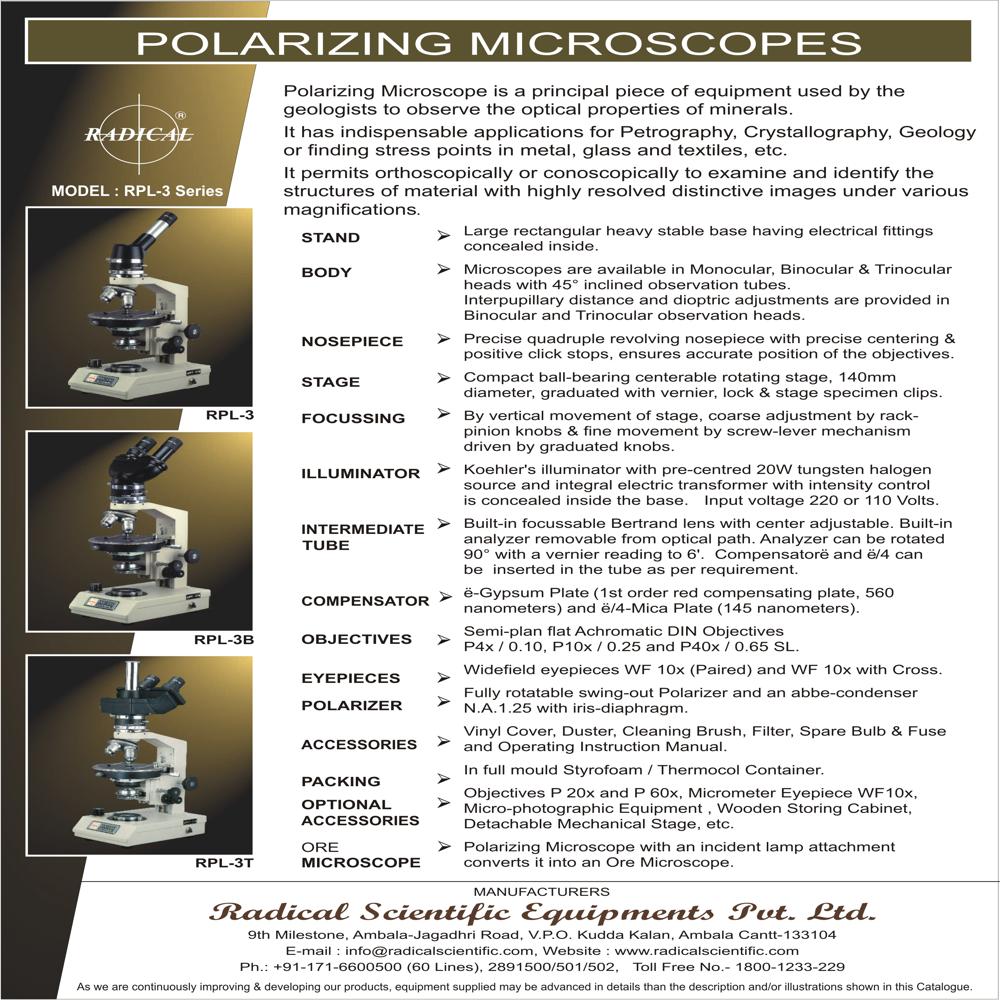
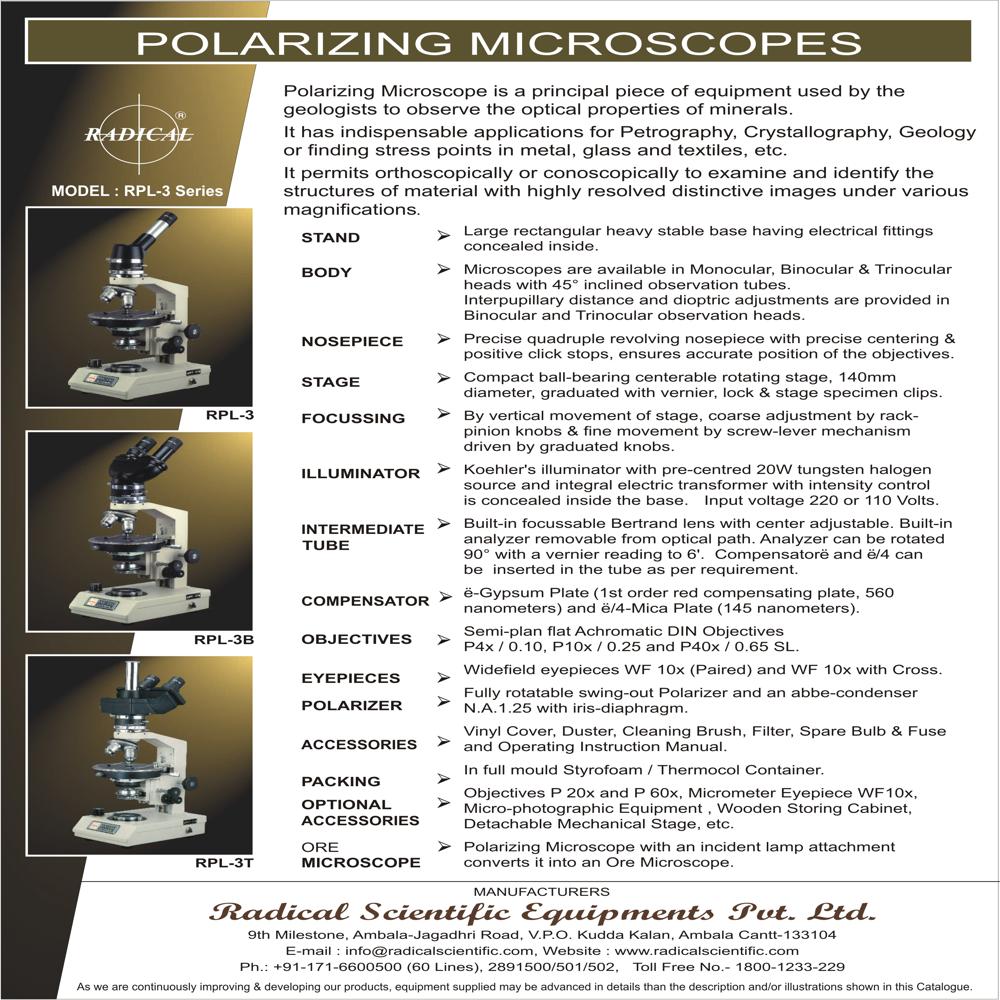
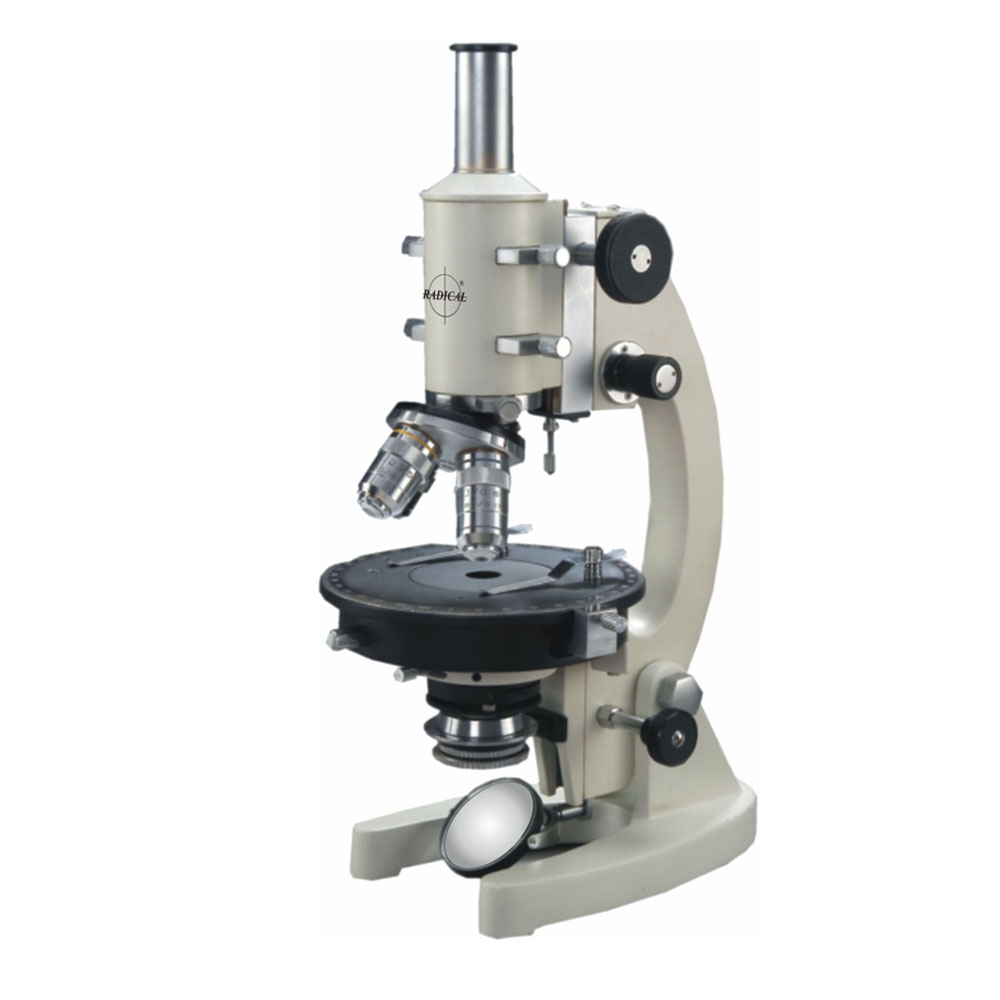
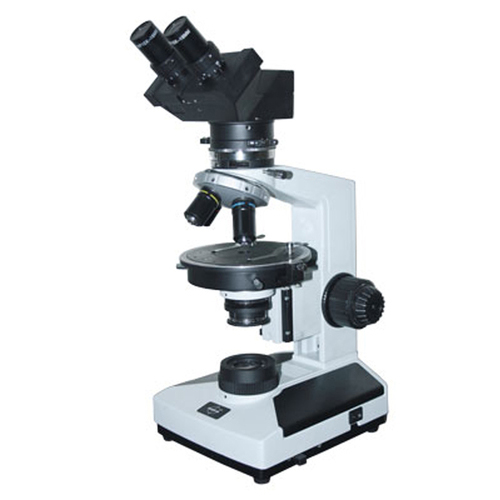
Stage -Compact ball-bearing center-able rotating stage, 140mm. diameter, graduated with vernier, lock and stage specimen clips
Focusing -By vertical movement of stage, coarse adjustment by rack pinion knobs and fine movement by screw-lever mechanism driven by screw-lever mechanism driven by graduated knobs.
Illuminator -Plano-concave mirror diameter 50mm mounted on gimble mount, interchangeable with sub-stage 15W lamp for 220V or 110V
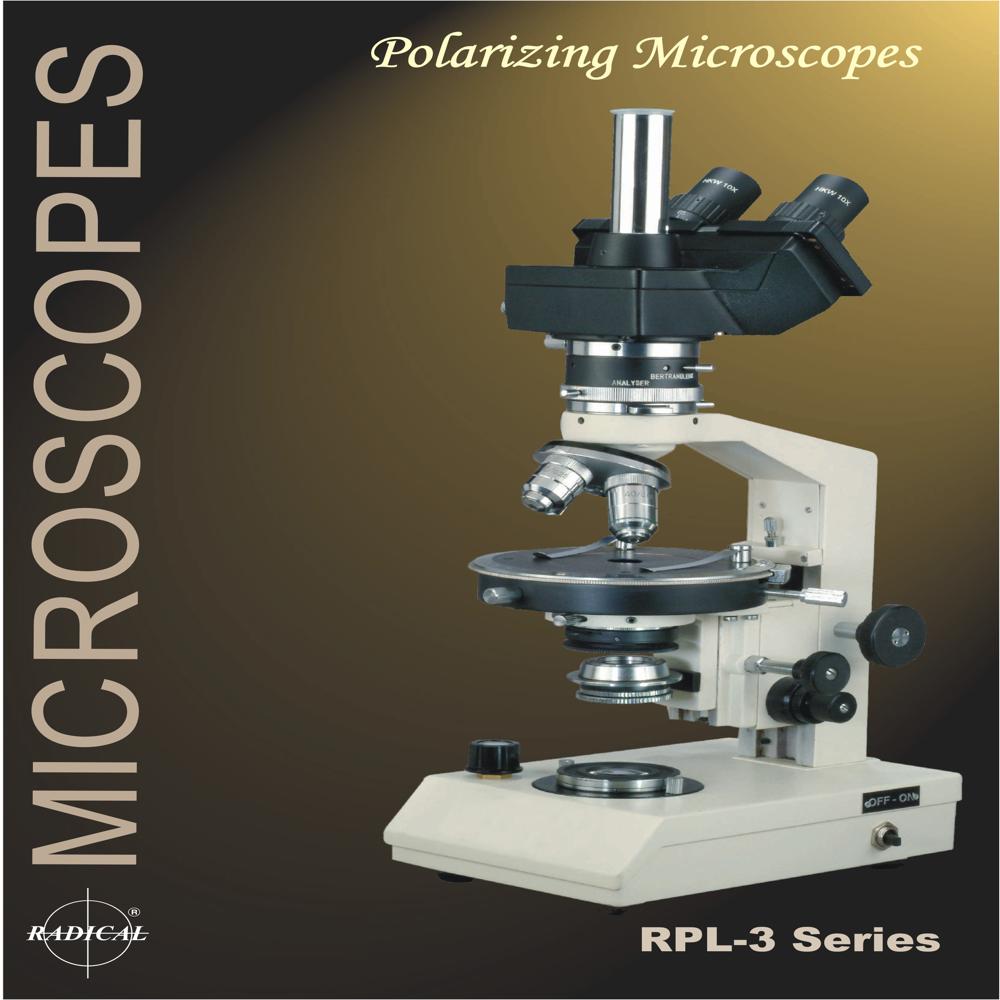
Intermediate Tube -Built-in slide out analyzer, Lamda-Gypsum Plate, Lamda/4-Mica Plate and focusableBertrand Lens. All slides are locked into the tube and can be inserted in the optical path as per requirement.
Compensator -Lamda-Gypsum Plate (1st order red compensating plate, 560 nanometers) and Lamda/4-Mica Plate (145 nanometers).
Objectives -Achromatic, Semi-plan Objectives P-4x, P-10x and P-40x SL.
Eyepieces -Widefield Eyepiece WF-10x and WF-10x with Cross
Polarizer -Fully Rotatable Polarizer on strain free abbe-condenser N.A. 1.25 with iris-diaphragm
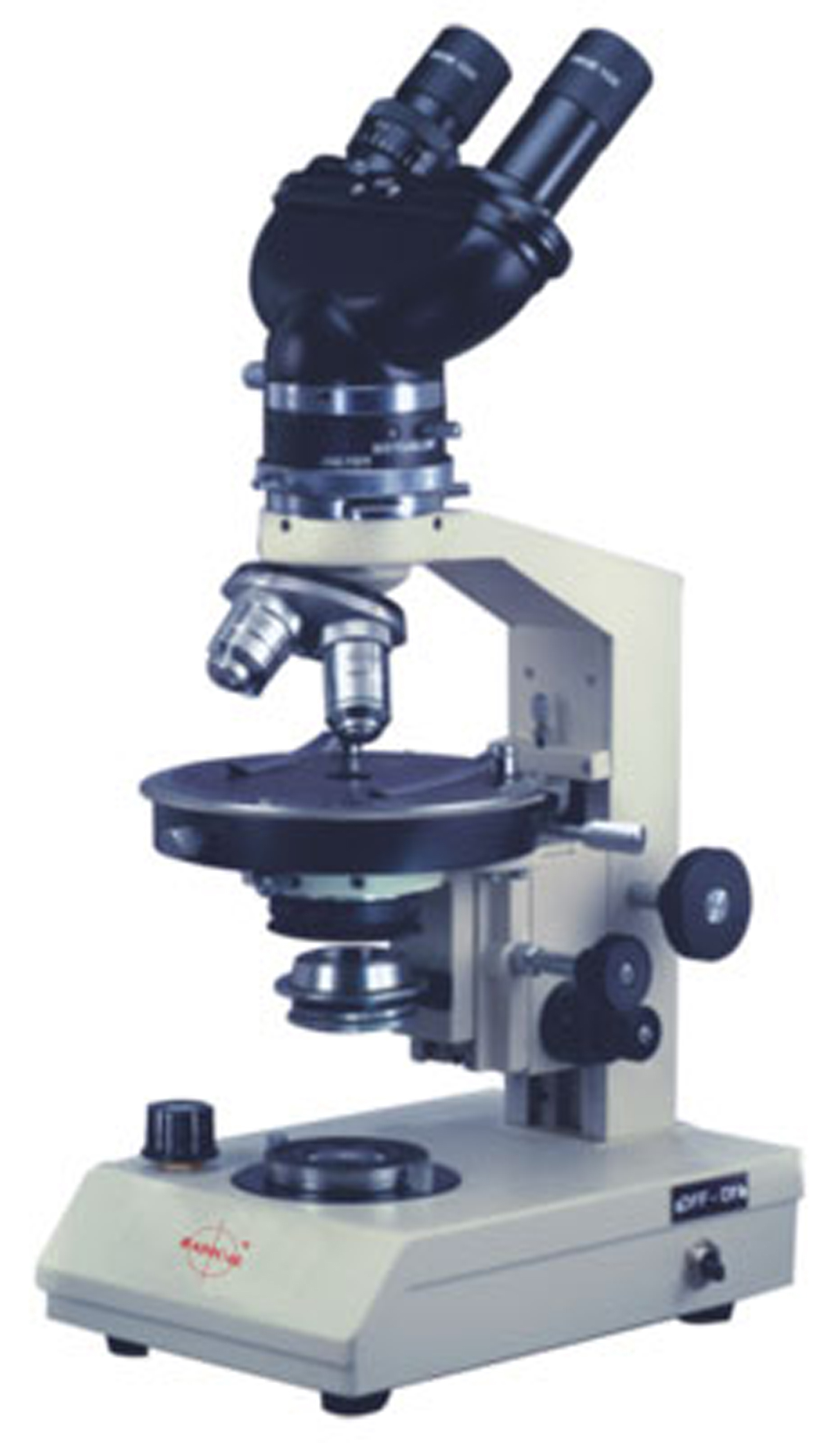
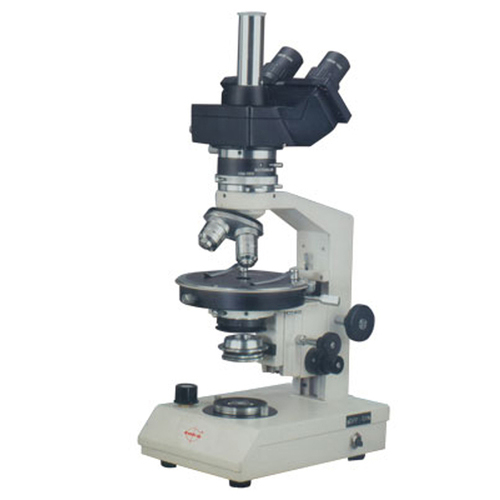
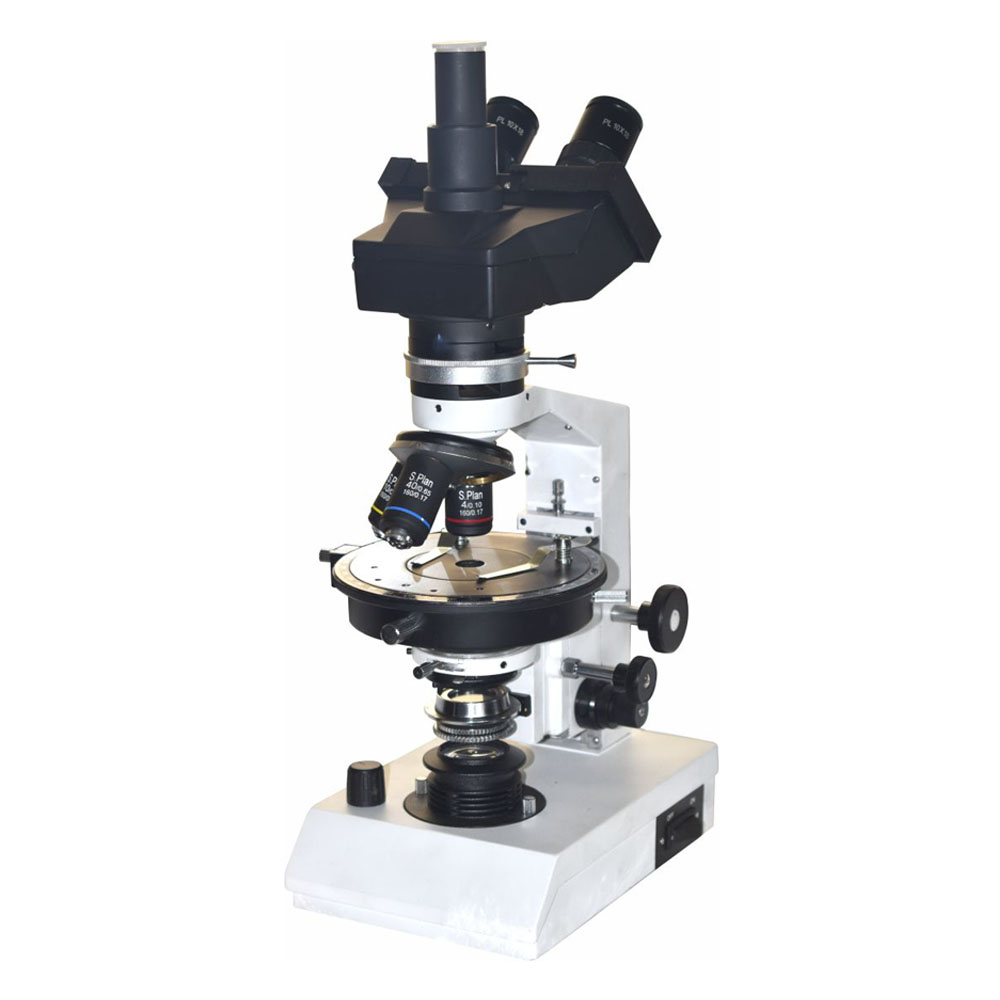
High-Quality Optical PerformanceThe RPL-3B delivers clear, detailed views of thin sections and specimens. The achromatic objective lens and wide field 10x eyepieces allow accurate examination of optical properties, while the advanced Abbe condenser and precise illumination support in-depth analysis for geology and material science.
Robust Binocular DesignConstructed from durable dia-cast material, the RPL-3B ensures longevity in laboratory environments. Its ergonomic binocular head provides effective viewing comfort for extended observation sessions, minimizing fatigue and maximizing productivity during mineralogical and metallurgical studies.
Versatile Illumination OptionsEquipped with both halogen and LED light sources, this microscope adapts to various specimen types and user preferences. Consistent, adjustable lighting highlights birefringence and stress patterns across a wide range of materials, such as metals, glass, and textiles.
FAQ's of Advanced Polarizing Microscope RPL-3B:
Q: How is the RPL-3B Advanced Polarizing Microscope best used in geological studies?
A: The RPL-3B is specifically designed for examining the optical properties of minerals and rocks, making it an invaluable tool for geologists. Its polarizing capabilities reveal details in mineral structure, composition, and stress points that are essential for petrography and crystallography analyses.
Q: What makes the RPL-3B suitable for identifying stress points in metals, glass, or textiles?
A: By utilizing polarized light and advanced optics, the microscope uncovers stress patterns and birefringence in a variety of materials. This feature is crucial for quality assurance and research in metallurgy, glass manufacturing, and textile analysis.
Q: When should I choose halogen versus LED illumination for microscopy work?
A: Halogen lighting is useful for high-intensity, warm color rendering, beneficial in identifying certain mineral features, while LED provides longevity and cooler operation-suitable for extended use or when temperature-sensitive specimens are being examined.
Q: Where can I purchase or inquire about the RPL-3B microscope in India?
A: The RPL-3B is available throughout India from authorized distributors, exporters, manufacturers, suppliers, and wholesalers. For procurement or support, you can contact these vendors directly or visit their respective websites for more details.
Q: What is the process for adjusting focus and lighting during examination?
A: The microscope is equipped with an adjustable rack and pinion system for coarse focusing. Illumination intensity can be modified using the halogen or LED light source and the iris diaphragm on the Abbe condenser to achieve optimal clarity for different specimens.
Q: What are the main benefits of using a binocular head for observation?
A: A binocular viewing head reduces eye strain and enhances specimen examination comfort, especially during prolonged observation sessions. This results in more accurate and efficient analysis, crucial for tasks in geology and material science.



 English
 Spanish
 French
 German
 Italian
 Chinese (Simplified)
 Japanese
 Korean
 Arabic
 Portuguese
 08045479132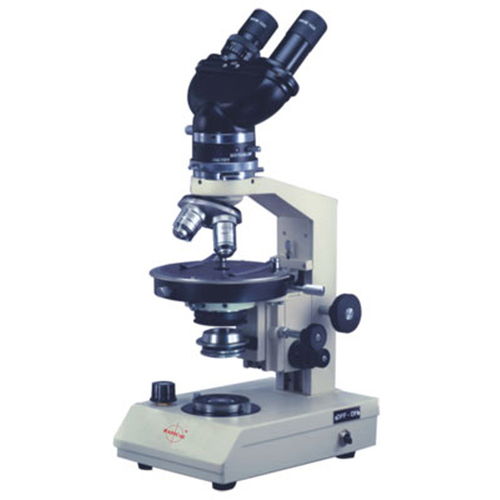



 Send Inquiry

 Send Inquiry
 Send SMS
