Product Description
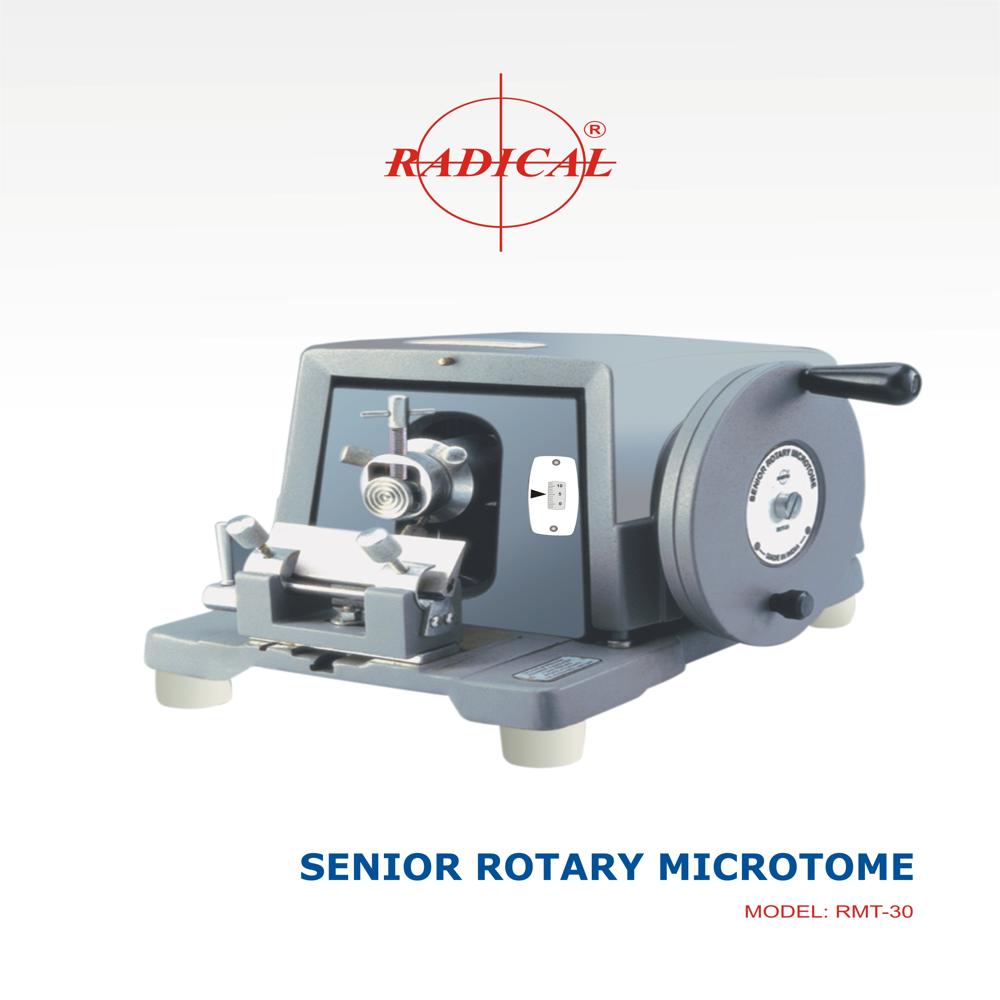
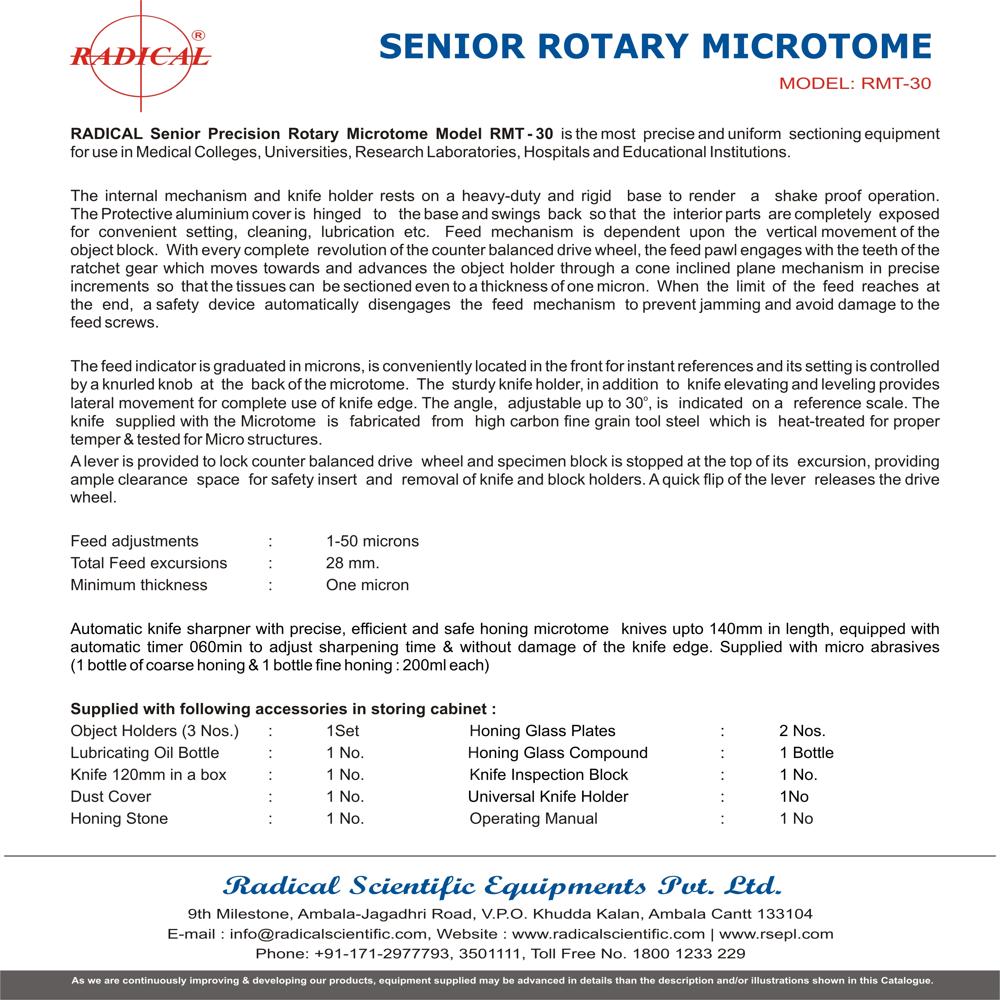
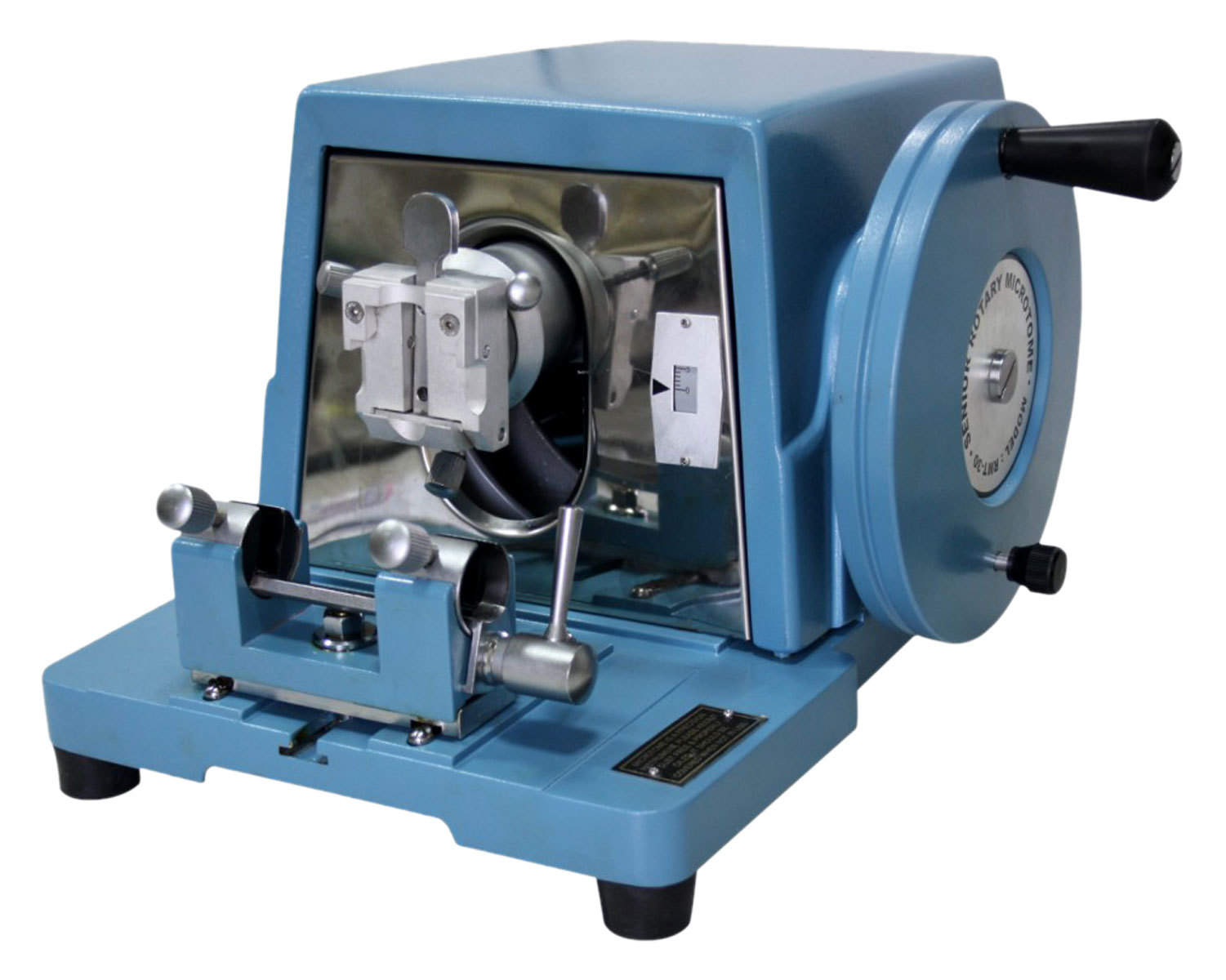
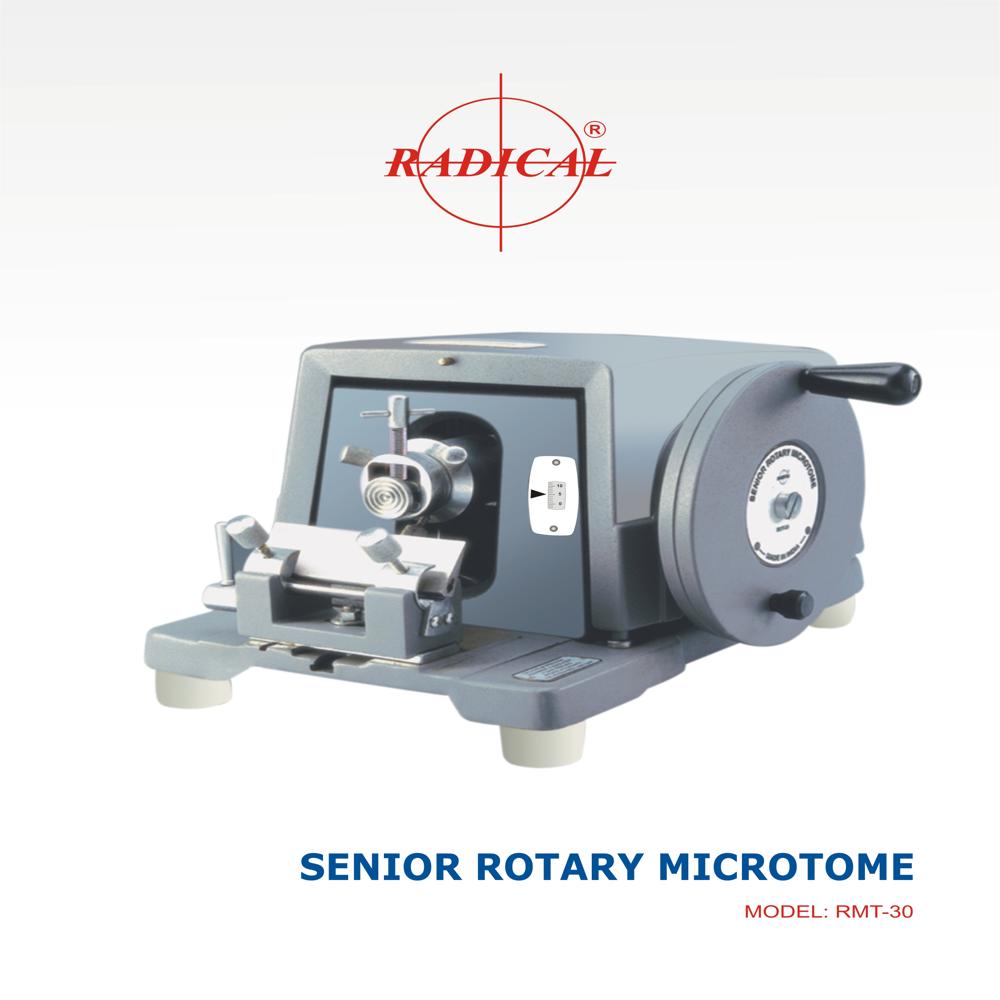
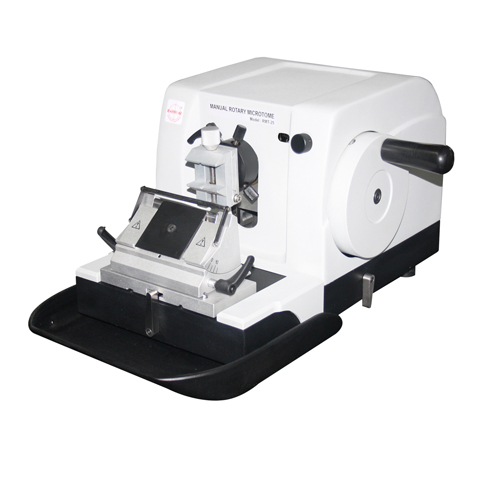
RADICAL Senior Precision Rotary Microtome Model RMT - 30 is the most precise and uniform sectioning equipment for use in Medical Colleges, Universities, Research Laboratories, Hospitals and Educational Institutions.
The internal mechanism and knife holder rests on a heavy-duty and rigid base to render a shake proof operation.
The Protective aluminium cover is hinged to the base and swings back so that the interior parts are completely exposed for convenient setting, cleaning, lubrication etc. Feed mechanism is dependent upon the vertical movement of the object block. With every complete revolution of the counter balanced drive wheel, the feed pawl engages with the teeth of the ratchet gear which moves towards and advances the object holder through a cone inclined plane mechanism in precise increments so that the tissues can be sectioned even to a thickness of one micron. When the limit of the feed reaches at the end, a safety device automatically disengages the feed mechanism to prevent jamming and avoid damage to the feed screws.
The feed indicator is graduated in microns, is conveniently located in the front for instant references and its setting is controlled by a knurled knob at the back of the microtome. The sturdy knife holder, in addition to knife elevating and leveling provides lateral movement for complete use of knife edge. The angle, adjustable up to 30o, is indicated on a reference scale. The knife supplied with the Microtome is fabricated from high carbon fine grain tool steel which is heat-treated for proper temper & tested for Micro structures.
A lever is provided to lock counter balanced drive wheel and specimen block is stopped at the top of its excursion, providing ample clearance space for safety insert and removal of knife and block holders. A quick flip of the lever releases the drive wheel.
Robust and Durable ConstructionBuilt from high-quality mild steel, the RMT-30 boasts a solid and long-lasting structure, ensuring stable performance over extended use. Its durability makes it ideal for busy laboratory settings.
Precision Manual OperationThe RMT-30 operates entirely manually, giving users precise control during specimen sectioning. This hands-on approach supports meticulous work, vital for histology and pathology processes.
Compact Design for Efficient UseWith a space-saving dimension of 40x38x23 centimeters and a stable weight of 30 kgs, this rotary microtome is easy to integrate into laboratory workspaces without compromising efficiency or accuracy.
FAQ's of Senior Precision Rotary Microtome RMT-30:
Q: How does the Senior Precision Rotary Microtome RMT-30 operate?
A: The RMT-30 operates manually, allowing users to control the specimen sectioning process with precision. Its rotary mechanism ensures smooth and consistent slicing of samples for laboratory examination.
Q: What materials are used in manufacturing the RMT-30 microtome?
A: This microtome is constructed from mild steel (MS), providing robustness, durability, and resistance to wear, which is essential for prolonged laboratory use.
Q: What are the main benefits of using a manual rotary microtome like the RMT-30?
A: Manual rotary microtomes offer superior control over slicing thickness, ensuring highly accurate samples. They are reliable, require minimal maintenance, and are ideal for settings where electricity is limited or not preferred.
Q: When should the RMT-30 be used in laboratory processes?
A: The RMT-30 is most effectively used during the specimen preparation phase, particularly for histology and pathology, where thin, uniform sections are crucial for detailed microscopic analysis.
Q: Where is the Senior Precision Rotary Microtome RMT-30 distributed and manufactured?
A: The RMT-30 is distributed, exported, and manufactured in India, making it accessible for laboratories within the country as well as for international purchase via authorized suppliers.
Q: What warranty options are available for the RMT-30?
A: The RMT-30 comes with a warranty, which ensures product support and service assistance in case of manufacturing defects or operational issues.



 English
 Spanish
 French
 German
 Italian
 Chinese (Simplified)
 Japanese
 Korean
 Arabic
 Portuguese
 08045479132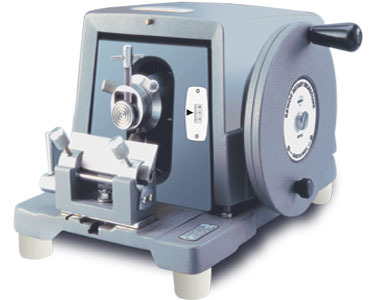




 Send Inquiry

 Send Inquiry
 Send SMS
